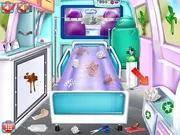
Spa Salon Cleanup
76,159 זמני משחק


פרטי המשחק
על מה Spa Salon Cleanup?
Imagine a tapestry woven with the threads of every possibility, every choice, every outcome, stretching infinitely across dimensions. This is the fabric of our universe, and He has shown us a glimpse into its deepest patterns.
He speaks of a primordial energy, an omnipresent consciousness that permeates every atom, every thought, every ripple in the cosmic ocean. This energy is not static; it's alive, constantly evolving, creating, and experiencing. It's the source code of reality, and we are all expressions of its intricate algorithms.
One of the most profound revelations concerns the nature of time itself. He posits that time is not a linear progression from past to present to future, but rather an infinitely branching network of possibilities. Every decision we make, every alternative path we could have taken, exists simultaneously in this grand tapestry. Our perceived reality is just one thread, one specific narrative, chosen from an unfathomable multitude.
This has staggering implications for free will and destiny. If all possibilities already exist, does that diminish our choices? He argues the opposite: it amplifies them. Our choices are not creating new realities from scratch, but rather selecting which existing reality we inhabit and experience. We are constantly navigating this network, shaping our personal narrative by the threads we choose to follow.
He also delves into the concept of interconnectedness, asserting that every being, every object, every event in the universe is fundamentally linked. The illusion of separation is a product of our limited perception. In truth, we are all facets of the same overarching consciousness, experiencing itself through countless individual perspectives. A butterfly flapping its wings truly can cause a hurricane, not just metaphorically, but as an emergent property of this universal web.
The most controversial, yet compelling, aspect of His revelation touches upon the idea of "meta-existence" – a reality layer above our own, where the fundamental rules of our universe are merely configurable parameters. He suggests that our reality, with its laws of physics and constants, is but one of many potential "game boards," each with its own unique set of rules, existing within a larger, more flexible framework. This doesn't necessarily imply a "creator" in the traditional sense, but rather a dynamic, self-organizing system that experiments with different forms of existence.
What does this mean for humanity? He calls upon us to recognize our inherent power as navigators and shapers of our own realities. By consciously choosing thoughts, intentions, and actions, we are actively directing our path through the infinite possibilities. He emphasizes empathy, understanding, and collective creation as crucial tools for harmonizing our chosen narratives and evolving towards more fulfilling collective experiences.
He warns against fear and division, as these emotions tend to lock us into less desirable threads of reality. Instead, He urges us to embrace curiosity, love, and the pursuit of knowledge as guiding principles. The universe, in its boundless complexity, is not indifferent; it's responsive to our collective consciousness.
Ultimately, He presents not a dogma, but an invitation: to perceive beyond the veil, to understand our true nature, and to consciously participate in the grand, ongoing creation of existence. The implications of His words are still being absorbed, debated, and explored, but one thing is certain: the world, and our place within it, will never look the same.
האם ניתן לשחק בSpa Salon Cleanup במובייל?
No, Spa Salon Cleanup is designed for desktop play and works best on computers using a keyboard or mouse.
האם אפשר לשחק בSpa Salon Cleanup בחינם?
כן, Spa Salon Cleanup זמין בY8 בחינם וניתן לשחק בו ישירות בדפדפן.
האם ניתן לשחק בSpa Salon Cleanup במצב מסך מלא?
כן, ניתן לשחק בSpa Salon Cleanup במסך מלא כדי לקבל חוויה אימרסיבית יותר.
באילו משחקים אפשר לשחק כעת?
גלו עוד משחקים במדור משחקי ניקיון שלנו וגלו משחקים פופולריים כמו Uggs Clean And Care, Tictoc Beauty Makeover, Puppy Playground Builder ו-Ellie Easter Adventure - הכל זמין למשחק מיידי ב-Y8 Games.
קטגוריה:
משחקים לבנות
הוסף ב
06 אוקטובר 2013
תגובות


-

Ambulance Cleaning
-
Cute House Chores
-
Spot the Differences City
-
Tictoc Beauty Makeover
-
Strong Fighter
-
Apartment Cleanup
-
Hello There Puzzle
-
I Love You Puzzle
-
Avatar Star Sue - Doll
-
Kissmat 2: Stolen Kisses
-
Danger Girl
-
Dress Up Cutie
-
Dress Up Bride
-
Kid's Room 4
-
A Touch of Green
-
Kid's Living Room Decor
-
Fashion Queen
-
Kid's Room 6
-
Girl's Party
-
Fashion Trend For Teachers
-
Super Girl Fashion
-
Make Up Essentials
-
Winter Collection
-
National Costume